Art in Word, Sound & Sight
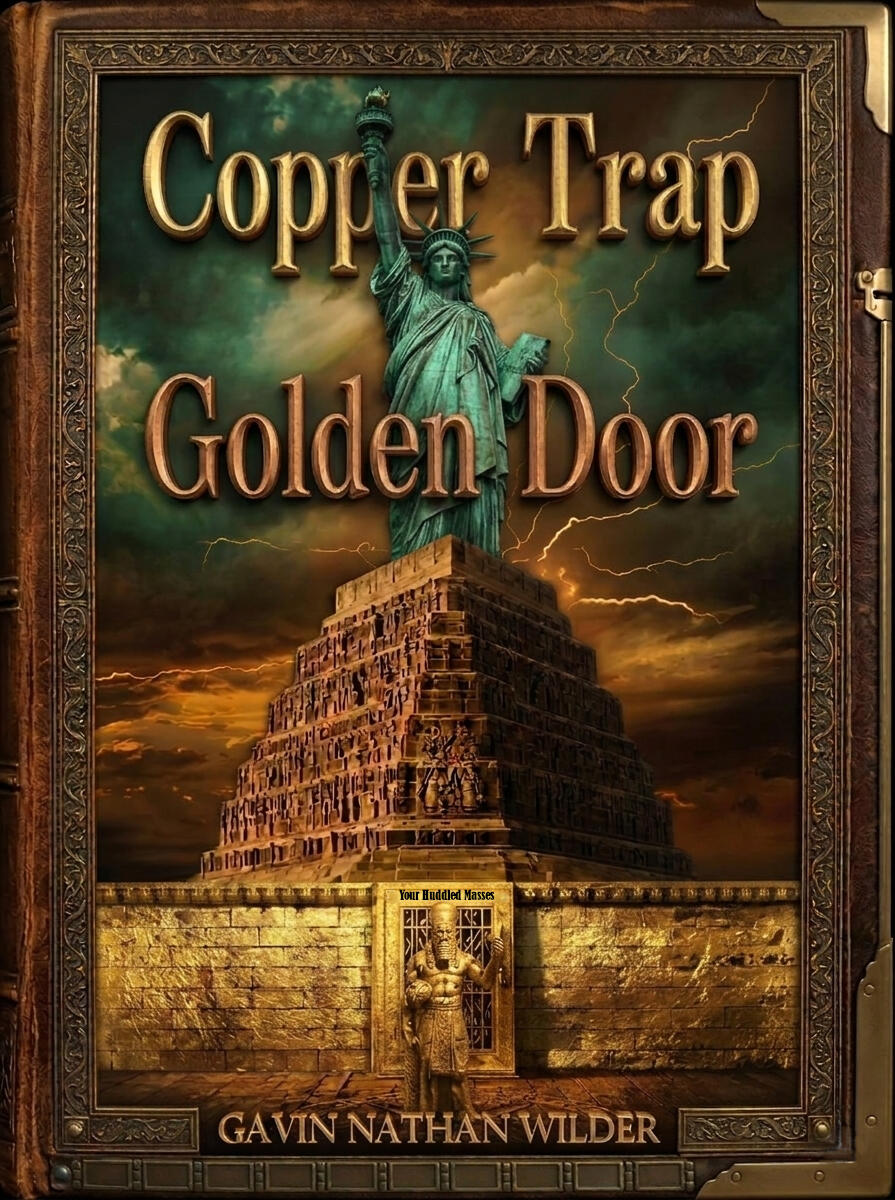
Copper Trap, Golden Door
Ancient forces collide with the modern world in this sweeping historical thriller. Grounded in real events, a centuries-old supernatural power makes a desperate move to resurrect a cursed vision—and rewrite human history.
Samples
LISTEN
YouTube
"Copper Trap, Golden Door"
Select Store, choose Papperback or Ebook









HOME
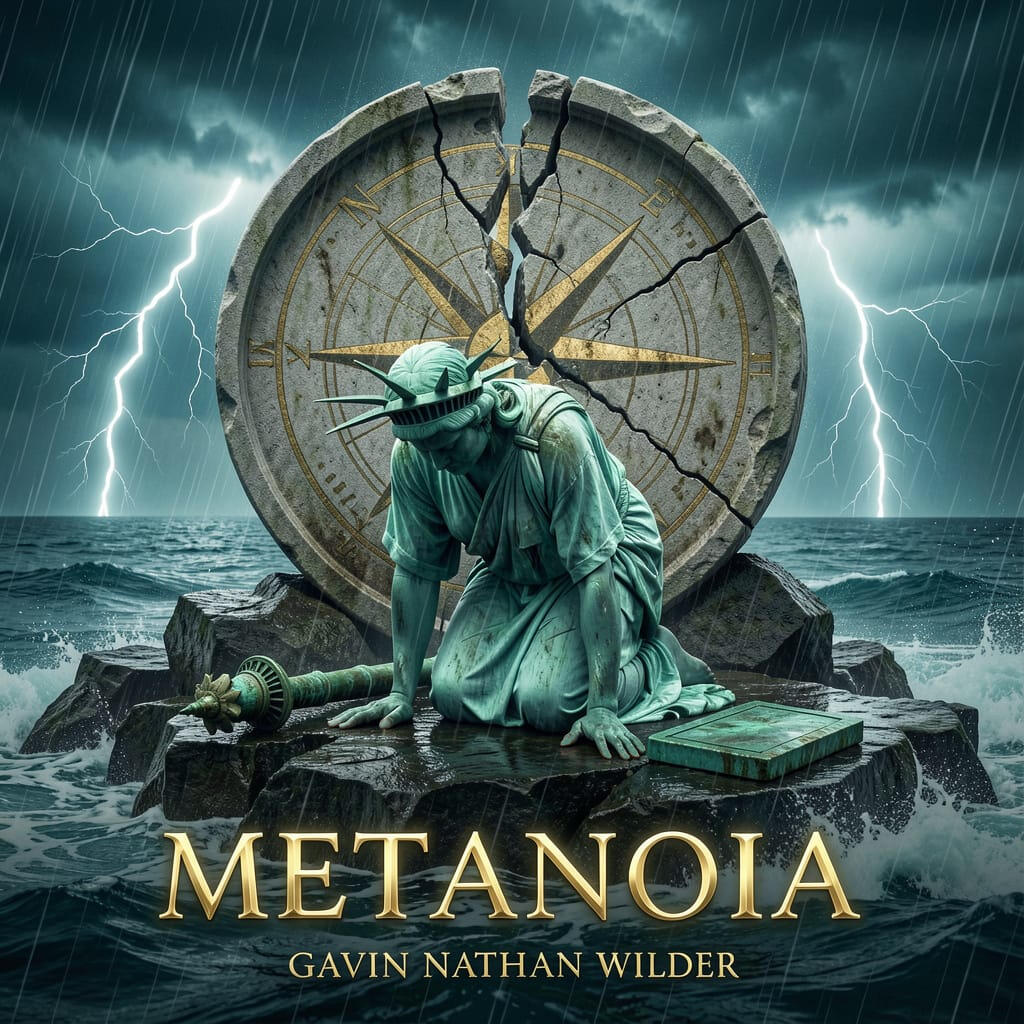
The music album "METANOIA" mirrors the novel "Copper Trap, Golden Door" and is available Free for a limited time. Check out "Trojan Poem" below. Enter your email for future alerts.
Subscribe for exclusive book, video, and music releases.
Sample Song
HOME
Thank you! Here are chapters 1-7 for you to read. We're working on the fomat code.
COPPER TRAP, GOLDEN DOOR
HOME
PREFACE
The characters are invented — but they are reflections of real people. The archivist who still believes the words mean something. The woman who feels the covenant before she can name it. The warrior who keeps his word even when it costs him. The builder who spends a lifetime serving something that will outlast him without ever asking whether it deserved his life. You may recognize them. You may be one of them.
The mechanism is not invented.
If you finish these pages and find yourself asking how much of this is real — that question is the book working as intended. Follow it. The documents are public. The pattern is patient. And the standard, as it turns out, still requires a keeper.
— Gavin Nathan Wilder
HOME
PRELUDE
Prometheus was only a distant memory — the ripple of an older hunger. Before the Greeks had a name for it, Gilgamesh and his bloodline had already reached for a fire not meant for them — eternity enough to stand beside their own Creator.He pressed the dream into his descendants like a brand, with unnatural urgency. Two-thirds otherworldly was not enough. In their eyes, eternity was a resource to seize, not a gift to receive. So they hoarded their sacred fire — as a captured right, never to be denied. A taboo fire fueled by pride — not theirs yet, but ageless hands reaching across time were closing the distance. Anything to extend their years until the next Tower arose, and its masters stood so high above the nations that all could achieve the ancient dream the fire had always promised — as above, so below. Eternal life. One Earth.
This was the crime. But not to them.
HOME
PROLOGUE
In the beginning, there was unity. Not peace. Not justice. Not freedom. Only one: one tongue, one dream, one tower clawing toward heaven.
The plain stretched vast and merciless beneath a sun that scorched the earth to withered grass. Two great rivers flanked it, their waters catching the light on knife-sharp ripples. The people who toiled upon it spoke one fluid language, and it sealed them in single purpose. They swarmed the rising structure in their tens of thousands, the air thick with tar smoke and the sweat of ten thousand believers. The tower was savage in its beauty — a ziggurat of sun-blasted brick, each layer sealed with glistening bitumen, broad steps marching upward in relentless tiers wide enough for even the giants among them. At its base the laborers raised their chant in perfect unison, the sound rolling across the plain like distant thunder.
At the top of a nearby ziggurat, seven cloaked figures made their way down, moving with the ease of those who have never needed to rush
— silhouettes against the sky, loose cloaks lifting in the wind. Like the moon in those days, dots of stars burning through even at noon; their wonder not altogether drowned by the sun.
Their skin carried a faint shimmer nothing like those who labored below. These were the sons and daughter of the great builder of Uruk. The eldest was tall, and he and his kin had eyes like black mirrors that drank the light.
Then the great one rose to his full height and lifted his hand to the sky. The work stilled. Silence rolled outward like a shockwave — only birds and whistling wind dared speak — then silence.
With a slow, sweeping gaze he took in the vast expanse, his pet lion held loose under one arm. He lowered his hand, and the world held its breath.
The lull broke.
His voice thundered off every surface.
“When this is done,” he said, and his voice needed no height to carry, “nothing above keeps us in the dirt. One tongue. One will. We go up and we take what they have — the gate, the tree, the fire — we take it and we do not come back down.”
The roar of his people moved through the stone. The tower rose higher.
The raqia above was getting close. Then the winds came.
Silvery clouds turned deep orange and black, rapidly curling around the tower. The blow came without shape or warning. One moment the tower stood; the next the sky was inside it. Stone met stone in a sound past sound — felt in the back teeth, in the gut — and the upper tiers simply ceased to be where they had been. They became air, then rubble, then a wall of it rolling downward and outward, taking scaffolding and men and the hazy morning light with it. No one ran the right direction. There was no right direction. The world had picked a new floor and everyone was finding it.
Yet even this was not the cruelest blow. The tongues were.
One moment the plain rang with unbroken speech. The next, a man turned to his neighbor and heard only noise. Meaning evaporated. Orders fell apart. The great chant shattered into bewildered cries. Panic raced through the masses and all labor stopped, all cooperation gone. The plain became every man for himself.
But at its heart stood the most powerful mortal on earth, the architect of walls and cities and now this last defiance of heaven. Rage possessed him as he watched his greatest work come apart.
His granddaughter — belly swollen with new life — had been standing at the base beside her husband, watching the construction from a small table set near the scaffolding. When the first shock hit she froze, hands on her belly, unable to move fast enough. Her husband grabbed for her, trying to pull her clear of the looming wall of failing stone.
The great builder was already moving, hurling himself down from the higher tiers. It isn’t that far. I can reach her. His back bursting with a power only the shining ones possessed. He leapt down shattered ledges, lungs burning, rocks glancing off his frame. Lightning branched across a violent sky, searing the air; the heavens spat judgment.
A bolt struck near them. Stone exploded. He caught one last glimpse
— his granddaughter’s hand reaching, her husband’s arms wrapped around her — before the rain of rock and wood swallowed them whole. “My rainbow!” The word burst out of him. He lunged toward the
heap, clawing at the rubble. “Maybe there’s a chance —”
“Hatzia!” he roared, hearing her screams behind him. “Stay back!” He was too late.
The children — Vyph and his six siblings, scarcely fifty years old yet already marked by the extraordinary vitality of their line — clung to the lower tiers. Dust and tears streaked their faces. Their blood gave them endurance but nothing more; they were powerless witnesses to the ruin.
A great block of stone and tangled beams took their father down just as he reached for them.
He lay pinned, ribs crushed, blood at his lips, his flesh closing almost as fast as the stone opened it — but his will burned clear. He locked eyes with his eldest across the wreckage as all his children ran toward him. Stones fell like rain around them. His eldest reached him first, then Hatzia. Their father, their king, looked deeply into his daughter’s grief-stricken face and, as gently as the noise allowed, said, “I know, my child…take my hand.” Then his gaze moved across all of them. “The Tower was to be a door — not a stairway. A machine, unfinished. Find a way that cannot be seen as I have mistakenly done. Let this be your
guiding purpose.”
“Flee, my children — I will be with you!” he thundered. “Return when the storm passes. Bury me deep. Never let the building cease. You must get the fire of life. You have a right not to die!”
They stopped. None of them wanted to move. “Go!” their father desperately pleaded.
Vyph wanted to refuse. Every muscle said run to him, lift the beam, claw the stones away. But the ground shook, the air burned, and the sky itself seemed to fall.
He turned away. He hated himself for it immediately and did it anyway.
His brothers and sister held each other up as they stumbled through powdered clay.
The mighty hunter strained against the weight. Then a second beam dropped, a sick thud through his chest. His hand moved once in defiance, then stilled.
Ninurta stood apart, shocked and silent, taking it all in. His hand found the copper necklace around his neck. Fingers closed around the hawk eye pendant and held it in private ceremony. Thick tears streamed out of his bloodshot eyes, soaking his face. “I will avenge this injustice.” The eldest’s composure cracked like the tower itself. Possessed with fury, he turned not against the father who had commanded him to live, but against the unseen hand that had shattered speech and struck from above. We too will be a hidden hand against you, he vowed in silence. Time will be ours.
For many days the stones still smoked. The sound of strange tongues grew fewer as the people scattered across the lands. The ruined tower lay like the broken spine of the world.
The eldest spoke into the smoke.
“We won’t go there,” he said. “We’ll draw our rights here. From below. From inside. Until there is no above left to answer to.”
No one argued. There was nothing left to argue with. Imhullu said it so quietly it was almost only breath: “As above… so below.”
Like the river beast finding a warm place to rest, it was done. Ninurta turned, frowning. “What did he say? I can never hear him.”
Hatzia turned toward the sound. “As above… so below,” she said, her voice still full of grief.
Amurru’s eyes lit. “Brilliant, Imh. Well said.”
“It will take much time,” said An, eyes on the smoldering tiers above. “I am satisfied with that. Time enough to reach the prize.”
“Patient as water,” said Abzu. “And as adaptable.”
Vyph looked from one face to the next, then back to the fallen crown of their first tower.
“Well then,” he said. “We are agreed.”
“As above… so below,” Imh whispered, and they answered low and in unison, like a prayer over the dead, the words settled into them like a mustard seed in the earth.
“So shall it be.”
The wind crossed the plain and took the ash with it and left nothing behind but the fractured sound of a hundred languages that would never meet.
The long work began. Not to ascend. To claim.
They melted into shadows. A father’s commission was their mission, vengeance their fuel; eternal life their purpose, their rite.
When the storm relented, the Seven returned. In the dark they performed their rites over the king’s broken body. They had learned already to avoid direct light; it weakened and burned them, made them less than solid, drove them toward the dark places of the Earth.
They unearthed his sarcophagus — eighteen feet of obsidian veined with gold, lions and rising structures cut deep into its surface. The air thickened as they sealed it with curses in dead tongues and wards drawn in their own blood. Slowly they lowered it into a vault carved beneath the ruined foundation.
It would lie there waiting until the work was nearly done.
And the children of Gilgamesh were not seen again. They slept, off and on, for thousands of years.
Ancient script names the ancient Beast, so these pages reveal its evolving feast. The tower rises, brick by brick,
while freedom trades its true intent, its mantle lost by subtle consent.
HOME
CHAPTER 1: Old Wine, New Flask
Golden light through old book dust, fanning in the high slanted windows of the Adams Reading Room, catching motes that drifted like memory. Marble pillars and brass railings framed rows of leather-bound volumes reaching toward the ceiling. At a desk near the center sat Dianya, a book open before her, reading aloud to the empty room — or to the ghosts she half-joked about — as if the words themselves were load-bearing.
“Interwoven as is the love of liberty with every ligament of your hearts,” she read, “no recommendation of mine is necessary to fortify or confirm the attachment.” Her half-moon glasses rested low on her nose. Around her lay stacks of papers and folders, the clutter of a curator at work — a life spent tending other people’s words.
Benjamin sat at his workstation a short distance away, sorting estate documents, cataloging the past one box at a time. He had grown up with his mother’s voice drifting over his homework; reading aloud was how she thought, how she prayed, how she argued with the dead. He half-listened now, accustomed to her rhythms — but even in repetition, Washington’s sentences still carried weight.
She continued, the urgency in the General’s words lifting her voice a fraction. The time was near, she read, which would decide whether Americans were to be free or enslaved, whether their houses and farms would be destroyed, whether unborn millions would suffer or be spared.
The fate of those yet to come would rest, under God, on the courage and conduct of this army.
Benjamin’s hands slowed over the papers. He knew this one. July 2, 1776 — orders given two days before the Declaration, a letter that had held men together on the edge of breaking, out in the mud and the cold. Dianya read the lines about cruel enemies and the stark choice between resistance and submission, about resolving to conquer or die, about honor and infamy and the eyes of the country on them. She reached the close — the call to rely on the goodness of the cause and the Almighty, to trust that a free man fighting for liberty on his own ground was worth more than any hired soldier on earth. When she set the book down, the room felt different. More still, as if the air had been
listening and now let itself out.
Benjamin drifted toward the wall where an ornate framed copy of the Constitution hung. He traced the inked We with his eyes the way a man traces a scar he’s stopped noticing. This wasn’t a list of values — it was a promise, a vow his forebears had made in his name, an experiment staked on ordinary people and the ones not yet born. Either he would help keep it, or he would be one more man who let a promise go quiet. Dianya looked over at her son. Her eyes had a light he recognized from childhood — the look she wore when something mattered more
than usual. “This is a good one, Nathan,” she said.
Without looking up he answered on reflex — she should call him Ben or Benjamin, that using his middle name was strange. She laughed, warm and unapologetic, and said she could always use the full meaning of it instead, which would be stranger still. He glanced up despite himself, grinning. They shared a quick laugh — the shorthand of a conversation they’d had a hundred times, an eccentric and affectionate language that belonged only to them.
Dianya opened another folder. Her voice softened the way it did with words whose weight she felt more than fully understood.
“The preservation of the sacred fire of liberty and the destiny of the republican model of government,” she read, “are justly considered as deeply, perhaps as finally, staked on the experiment entrusted to the hands of the American people.” She closed the folder and held Benjamin’s gaze a moment longer than usual.
A moment passed between them — weighty, tender, like a hand placed on a shoulder in the dark. “April 30, 1789,” she said. “First inaugural address.”
He heard the weight in her voice and gave it his full attention. He asked why that one.
She shrugged, but the motion had a weight she couldn’t put a name to. It had simply seemed right today. She gathered her papers, came past his desk, and paused long enough to squeeze his shoulder — brief, firm. “Don’t stay too late.” He said he never did, and meant it, even if the stacks could quietly swallow hours when no one was paying attention. Near the doorway she stopped again, as if a thought caught her. “Oh — order a print of George Washington kneeling
at Valley Forge, please.”
“Why that one?” Benjamin asked.
She chuckled. “Well, at least someone will be praying around here.” Her footsteps echoed down the marble corridor until the library’s quiet took them.
Her uneasiness was complicated. He couldn’t place it. The air had the feel of the hour before a storm — heavy, waiting, balanced on an edge that could tip either way. He looked back at his work: estate documents, correspondence, the leavings of other people’s lives. On top of the pile lay a cream-colored folder he didn’t remember pulling. The card-stock was thick and slightly worn at the edges, a file kept for things too fragile for regular handling.
He frowned and opened it.
Inside was a letter, handwritten in a script he recognized from countless archival pages but had never seen waiting like this — as if it had been placed there. The heading read: Benjamin Rush to George Washington, Valley Forge.
The sight of the ink stopped him cold. Not beautiful penmanship, but plainly real — the pressure of the quill, the slight tremor in the loops where cold fingers had worked in winter light.
He read the first line. My dear General, the flame is nearly extinguished. If it falls, I fear what darkness will follow… The words reached across two and a half centuries and found him — old, patient, easily finding the place where they fit.
“Bad news?”
Benjamin startled. He hadn’t heard the side door open. Lily Madison stood just inside the reading room rope, visitor badge clipped to her blazer, a slim folder held against her chest as if she was half-afraid to disturb the air. The late light from the high windows caught the warm brown in her hair and turned the edge of her white blouse to gold.
“You’re fine,” he said, a little hoarse. “Just — old bad news.”
“How’re you doin’, beautiful?” he added before he could think better of it, the words slipping out easier than most things he said to people.
“I’m fine,” she answered, surprise moving into a smile.
“Yes, you are,” he said, quiet but plain. Her smile deepened. Her eyes moved past him, settling on his backpack propped against the desk leg — and the library book resting on top of it, thick and plainly
old, its spine faded to the color of weak tea.
“Turris Babel,” she read, tilting her head slightly. “What’s that?” “Kircher,” he said. “Athanasius Kircher. A Jesuit scholar, 1679. He
tried to calculate the exact physics of the Tower of Babel — how tall it would actually need to be to reach heaven. Concluded the mass would tip the planet off its axis before it got close.”
Lily blinked. “So he did the math on human ambition.”
“And found it structurally catastrophic.” The corner of his mouth lifted. “Borrowed it this morning. Haven’t gotten far.”
She looked at it a moment longer — half amused, half genuinely interested — then her gaze came back to the desk. “Washington?”
“Rush,” he said. “Benjamin Rush. To Washington. Valley Forge.” “The doctor,” she said. “Bleeding and blisters and pep talks.” One
corner of her mouth tilted. “Cheerful combination.”
He huffed a laugh. “Something like that.” He turned the page so she could see. “He thought the fire was going out. Here.”
Lily read in silence, lips moving faintly. At nearly extinguished, a small line formed between her brows. At darkness will follow, her fingers tightened on the folder.
“Feels familiar,” she murmured. “To you?”
“To now,” she said. “I know, dramatic. It just — sometimes it feels like we’re living in the dark part. After letters like that didn’t work.”
Most people kept thoughts like that wrapped in irony, or didn’t say them at all. She just set it down between them, next to the ink and the dust.
“Maybe it hasn’t failed yet,” he said. “Not completely.” She met his eyes. “You really believe that?”
He should have hedged. Instead: “I believe it matters that some people can still see the flame at all.”
What Benjamin said moved her — from him, she felt how real it was. For a moment the space between them felt smaller than the distance across the desk, the whole reading room narrowing to the worn paper and the question hanging over it.
“Well,” she said, smile coming back, softer now, “if you ever turn this into a class on seeing the flame, I want a front-row seat. I read this stuff. You — you hear it.”
The words meant more than any professional praise. He looked away, suddenly aware of how close she was. “Careful. I give too much homework.”
“I like homework,” she said. “The right kind.”
She set the folder on his desk, then held still for a moment, weighing something. Before he could ask, she leaned in — quick, light — and brushed her lips against his cheek. Warmth, the faint scent of her shampoo, the briefest pressure, like a match touched to tinder.
“Thank you,” she said, close enough that he felt the word as much as heard it. “For caring about this when most people don’t.”
She pulled back, eyes bright, a little nervous. “Sorry. That was — probably weird. Long day. Sacred fire. Blame Washington.”
His brain gave him nothing useful. Heat climbed his neck. “It’s —” He cleared his throat, a smile getting through. “Just an unexpected, but pleasant surprise.”
Her smile turned almost mischievous. “Good. Keeps the flame from going out.”
She headed for the door, her step lighter. “See you around, Big Ben.” He let out a quiet laugh. “For sure. See you soon, Lily.”
When the room was quiet again he realized his hand was still hovering where her lips had been, as if his skin hadn’t gotten the message she was gone. He dropped it to the desk and noticed his notepad. Somewhere between her first question and that impossible thank-you, his pen had drawn the rough outline of a small layered flower that looked a lot like a rose.
He looked at the sketch, then at the door she’d gone through. The grin on his face got away from him, and it felt good — like she had yanked a curtain back and let sunlight into a room he hadn’t known had gone dim.
HOME
CHAPTER 2
Standard in the Stacks
In Benjamin’s dream, the Liberty Bell vibrated under an invisible weight, the old fracture humming like a struck nerve instead of ringing like metal. He knew this even inside the dream — knew the famous crack had been there since 1846 — but now it was spreading, branching across the bronze like frozen lightning. The sound was wrong: not the clear tone of school trips and documentaries, but a grinding, low stress, as if something very old were giving way under a
load it had never been built to carry.
Someone stood in the shadow beneath the bell. A woman in a dark dress, her face blurred and shifting whenever he tried to look at it directly, as though the dream itself refused to show him. She held something that might have been a flag; the stripes ran together like watercolor left out in the rain. When she spoke, each word defined, like the bold signatures on the Declaration of Independence.
“The standard requires a keeper.” The words hit like a thunderclap. The bell split wide open.
Benjamin woke gasping, sheets twisted around his legs. The clock read 7:04 in cold blue numbers. He stared at it until his breathing settled. Just a dream. Stress. Too much time buried in old papers.
He told himself that through the shower, the coffee, the small rituals meant to convince the body the mind was steady.
The dream slipped the way dreams do — details going faster the harder he reached for them. By the time he was dressed and out the door, he had almost convinced himself it meant nothing.
Almost.
The coffee shop was busy. Benjamin ordered his usual — black, no sugar — and waited at the counter, scrolling his phone without seeing a word.
“Benjamin!”
He grabbed the cup and turned. A receipt was stapled to the sleeve.
$1.76.
He stopped. One seventy-six.
His brain offered the reasonable explanation immediately: coinci-dence, coffee was cheap here. He filed it and walked out into the morning.
Then he saw her.
A woman sat alone by the window in a dark, high-collared dress, her hair pinned under a small cap that belonged to another century. She was looking straight at him — not glancing, not casually noticing, but fixed on him with the steady patience of someone who had been waiting a very long time.
He looked away, then back. She hadn’t moved. Hands folded in her lap. Face calm and still.
He took one involuntary step toward her.
Someone cut between them. When the stranger passed, the chair was empty. No cup. No bag. Only the faint impression in the cushion.
Benjamin stood in the doorway with cooling coffee and the break of a cold sweat, now knowing what it means when someone says… “looks like they’d seen a ghost.”
The numbers followed him all day. 7:04 on a wall clock. In the break room, an older staffer laughed to a student assistant: “Seventeen! I’m seventy-six — can you believe it? Seventy-six and still hauling boxes.” By the third time his rational voice started in about pattern recognition, confirmation bias. Perfectly normal. Except it didn’t feel normal. It felt like a tap on the shoulder he couldn’t locate.
Late afternoon. He left work wound tight, walking without a destination. At a busy crosswalk the light turned red. He stopped at the curb.
Across the intersection, she stood.
The same woman. Dark dress. Perfectly still while the crowd moved around her like water around stone. In her hands, a flag — rough canvas, thirteen stripes faded, thirteen stars in a circle. A Betsy Ross flag on a twenty-first-century street corner.
Their eyes locked across four lanes and a hundred strangers.
A bus roared through. When it cleared, she was still there. Same posture. Same unbroken gaze.
The light changed. The crowd pushed forward. Benjamin couldn’t move until someone bumped him hard from behind. He stumbled into the crosswalk, eyes on her. Ten feet. Five.
A bicycle bell rang sharp. He flinched, looked away for half a breath. When he looked back, she was gone.
The flag leaned against the light pole. Real. Canvas shifting in the breeze.
He reached out. His fingers found rough fabric — the dye worn nearly away but unmistakable. Thirteen stripes. Thirteen stars. The union before it grew.
The Liberty Bell, the dream, Washington’s orders, Rush’s letter, his mother’s voice in the Adams Reading Room — all of it came together in one instant. The same war. The same winter. The same language about a flame that must not go out, now wrapped around his hand in heavy, impossible cloth.
He pulled back as if burned.
The light cycled. People moved on. No one else seemed to notice. Benjamin stared at the pole until he couldn’t hold still any longer.
Then he lifted the flag, folded it the way he had seen in a hundred old photographs, and walked with it pressed tight against his side. He told himself there would be a reasonable explanation tomorrow.
By the time he reached the metro, he had almost convinced himself. Almost.
HOME
CHAPTER 3
Defend the Fragile
The Liberty Bell came back that night like a breath kept too long.
Silence first.
Benjamin stood in dream-dark under the old bronze throat, close enough to see the 1846 scar — that one crooked line down the face of history. Tonight it wasn’t still. Hairline fractures crept outward in slow strokes, thin as pencil lines at first, then opening into jagged tributaries chewing across the metal. The bell didn’t ring. It groaned — low and wrong, like a promise asked to carry more than it was made for.
This, he thought, without quite thinking it, is what we do. We crack. Someone was beneath it.
A woman in a plain dress that had never heard of zippers, cloth falling in honest, simple folds. Her face never quite settled — whenever he tried to catch her features, the dream smeared them. In her hands she held a flag — or what was left of one — stripes bleeding together the way watercolor does when the sky opens up. When she spoke, the air around felt purposed, a placed moment, like paper under a poised pen.
“The standard requires a keeper.” The old crack flared.
The single wound burst into a web, bronze pulling apart under invisible pressure until light pushed through the gap. Deep inside the hollow, something caught the glow — a small circle of metal, turning once, slow, like a coin settling at the bottom of a well. A compass, his mind named it, from somewhere older than the dream.
The bell tore itself open.
He woke halfway through the fall.
Sheets knotted around his legs, lungs pulling air, the dark room trying on other shapes until his eyes found the red digits on the nightstand.
7:04.
Again.
He lay still, taking controlled, conscious breaths until his heart evened to a normal pace. Shower. Clothes. Coffee. The usual order — but every movement dragged against a low sound he couldn’t quite place.
Steam took the dream’s edges. The woman’s dress, the exact pattern of the cracks, the glint of the compass — all of it tried to go. One sentence held. One number held. One thought stayed, stubborn as grit under a nail: bells crack because the metal is what it is, not what you wish it were. People aren’t any different.
In the kitchen, the flag waited where he’d left it, folded square on the table like a question someone had mailed without a return address.
Daylight was not kind to it. Under the flat gray of a D.C. morning the fabric looked tired but not ready to quit — the off-white of smoke and handling, not factory dye. Thirteen stripes. Thirteen stars in a tight ring. The pattern his brain had filed under paintings and museum glass, not under yesterday’s traffic light and a public bench.
He circled the table.
Up close, the canvas smelled faintly of dust and something older — old wood, old fire, old sweat. He rested his fingertips along the edge without picking it up.
There were easy stories he could tell himself. A film crew nearby. A reenactor with more passion than sense. A replica left behind after a bad afternoon. All possible. None of them explained why he had heard the sentence before he saw the flag, or why 7:04 had started trailing him like it had something it needed to say.
So he called a man whose work lived in the narrow space between superstition and evidence.
They met that afternoon in a windowless office off one of the Library’s quieter hallways — fluorescent lights, no personality, one of those rooms where one file becomes a library stack. The appraiser arrived on time, carrying his years easily but not carelessly. His tie had seen better decades. His leather case had been down enough hallways to know when to keep quiet.
“You said you have a flag that ‘shouldn’t be where it was,’” he said, setting the case down with the ease of someone used to fragile things. “That’s a refreshing change from ‘I found this in my grandmother’s attic, is it worth millions?’”
Benjamin managed a shadow of a smile and opened his bag.
The thirteen stars looked up from the table, stitched into a circle that meant unity before the word became a logo. The stripes had gone from bright to something closer to dried brick. The seams showed their history: small hesitations, tiny corrections — the work of a person, not a machine.
The appraiser stopped talking.
He looked for a long moment, the easy banter draining out of him. Then he reached for cotton gloves and pulled them on with the careful habit of long practice. His fingers traced the edge of the cloth, skimmed a seam, paused over a faint repair.
“This,” he said slowly, “is not the sort of object one leaves on a public bench.”
Benjamin heard it echo the dream in a different key: the standard requires a keeper.
“So — not from the discount bin,” he said, reaching for light and landing somewhere shy of it.
A corner of the man’s mouth moved, but his eyes stayed on the flag. “If it’s a reproduction, it’s the most convincing one I’ve seen in years.
The weave, the thread, the dye — whoever made it knew exactly what they were copying, and why.” He lifted a corner just enough to see the underside. “And if it’s not new, it survived more years than either of us has any business expecting.”
“Could it be stolen?” Benjamin asked. “From a collection?”
“If a major institution had lost something like this, I’d have had three phone calls and a headache by now.” He shook his head. “But not every flag like this started life in a glass case. They rode into storms, got folded on tired laps, stuffed in trunks. Some never made it into any catalog. Unwritten things can still be true.”
He looked up, sharper.
“However it reached you — don’t treat it like decoration.”
The words took hold, heavier than they should have been.
“What do you want me to do?” Benjamin asked.
The appraiser looked at the flag a beat longer, then answered like a man who’d decided against softening it.
“Treat it as a period piece until someone proves otherwise. Write down everything — when you found it, where, who’s touched it. Don’t wash it, don’t ‘fix’ it, don’t loan it to anyone who hears the word patina and reaches for a scrub brush. If you’re willing, I’ll have a lab look at the fibers and dyes. Quietly. No press releases.”
Quietly. No fuss.
They took photographs. They talked about humidity and storage and paperwork that makes most people’s brains tune out. When the appraiser left, the room felt larger and emptier at the same time.
The flag stayed on the table — small and dense, like someone had folded a decade and never gotten around to opening it back up. Somewhere above his head, tourists were running their fingers over We the People and photographing a bell that would never ring again. His mother’s voice moved through the space like a draft — Washington’s words about a sacred fire, Rush’s warning about darkness, that inaugural line about an experiment entrusted to ordinary hands.
The bell. The flag. The letter. His mother’s voice. He kept turning them over one at a time and they kept coming up the same side. Not metaphors — the same wound, dressed differently across three centuries. Someone had always known people would forget. Had counted on it. Had been patient about it in a way that felt almost worse than rage.
His work until now had been backward-facing. He had shelved courage after the fact, boxed conviction, filed repentance, stacked regret. He tended to promises once they were already broken or kept.
This felt different.
This felt like something from the founding winter had stepped off parchment, walked down marble stairs, and laid itself across his table
— waiting to see if he would pretend not to recognize it.
What it was asking, if he was hearing it right, wasn’t to fix human nature once and for all. It was to keep interrupting the drift. To keep showing the crack. To keep ringing — even if the sound came out rough and wounded.
He reached out and set his hand flat on the folded cloth. It was just canvas. It was not just canvas.
“All right,” he said, barely above a whisper, not wanting to disturb whatever was watching from the edges. “If I’m supposed to remember
— I’ll remember.”
No voice answered.
An inner voice answered — a place he hadn’t known was waiting. His spirit said yes before his mind could argue.
HOME
Chapter 4
Machiavellian Cabal
In a chamber far removed from daylight, seven figures sat around a table of black glass veined with green marble. The room was circular, its walls lined with shelves holding Sumerian figurines
and relics of forgotten empires — not displayed so much as stored, the way a man keeps tools he expects to use again. They caught the low light softly, witnesses to a council that had met a thousand times before in a thousand different rooms, always arriving at the same conclusions. One thick glass case stood empty behind the head seat. It had stood empty for centuries. Tonight it seemed to pull the dim light inward, as
if it had been waiting a long time for what it had been promised.
The air was colder than it should have been. Not a draft — the temperature had simply dropped, the way it does in places where something old has been patient for too long.
They were striking, all of them — tall and well-made, their black hair and unblemished pale skin belonging to no particular place and no particular era. The tallest wore his hair cut with military precision. Others let it fall like ink over their shoulders. Variations on one template, with eyes like polished onyx that took in light and returned nothing.
If you looked at them too long, something that resembled humanity flickered briefly in those eyes — and then it was gone, and what was left was simply the dark.
A faint, irregular ticking came from somewhere inside the walls. Not mechanical. Not alive. Just present — the way certain silences are present.
Vyph, the tallest, rose barely enough that the others felt it without quite seeing it. His charcoal suit was the heaviest and most exact in the room, every seam correct, his matte black tie perfectly straight. When he spoke, the conversations around him didn’t trail off. They re-aligned.
“Hatzia has been seeing.”
The words settled the way stones settle in still water. No one moved.
Hatzia sat at his right, midnight jacket sharp over a softer blouse that whispered when she moved. Her fingers rested on the black glass. Now they curled — something sharp moving under her skin from inside.
It was spreading.
Her eyes softened, drifting somewhere past the room. Her pupils widened as though responding to a frequency the others couldn’t hear. The cold deepened around her chair.
“Not just the artifact,” she said, barely above a murmur. “There’s a pull. East of the river. Stone, glass — a dome. What mortals call the dome.”
Her lips parted slightly, tasting the air. Something metallic settled on her tongue.
“He feels—” She stopped. Her face became unsettled for a moment, against whatever image had come up. “The Standard again. Individual liberty. That old notion of sovereign souls answerable to no one but their unseen Giver.” Her voice roughened on the last syllable — a hairline crack in the composure. “Stubborn. Frayed. Still choosing.”
For Hatzia, the Standard was not a philosophy. It was a pressure point — words that carried both pity and the bone-deep weariness of someone who had felt too many nights end with other people’s terror soaking into her skin.
“It must be stopped,” she said. No softness. Steel wrapped in silk.
Abzu, two chairs down, tilted his head. His suit hung looser than the others’, good fabric falling in easy lines, his collar open one button. Behind him a carved stone figure watched — a robed man with a tall split crown. Abzu’s deep blue-black tie fell in a narrow straight line, a downward mirror of silk.
“Stopped, or turned?” he asked, voice low and almost gentle. “A stream can be redirected. Let it flood him slowly and he’ll think the new channel was always there. No need to break what can still be dissolved.” The last word lingered between them — soft as mercy, heavy as drowning.
Across from him, Ninurta’s eyes intensified. His suit carried the quiet weight of a uniform. He sat very straight, shoulders squared, hands open on the table like a man standing at attention on an invisible parade ground. His knuckles whitened.
“You would drown him without letting him see the wave,” he said. “There’s no honor in that.” His hands flexed once on the glass, then stilled.
“Honor is a story you tell yourself so you can sleep after the killing,” Hatzia said, not looking at him. “I’m the one who feels them when they wake.” Her fingers pressed harder into the glass. Tiny threads of frost spread from her touch and vanished.
Amurru — the smiling one, the wanderer who had spent ages living in other people’s skins — let out a soft, amused breath. His tie carried a faint pattern, his cut a shade slimmer than the room called for. He sat back as if the old chamber were a hotel bar, adjusting his cuff with a motion too easy and too practiced to be casual.
“The Standard is rising again,” he said. “Flags, stories, founding documents — same instrument, different era. This time it wears the face of personal freedom, the liberty to kneel to no throne but one’s own conscience. Speak to the bearer correctly and he’ll walk where we want him.”
Where Hatzia felt the Standard as a wound that never fully closed, Amurru treated it as a script — the words slid out like a pitch dressed in the clothing of perfect understanding. But his smile faltered long enough for the room to notice.
“You’ve never stayed long enough to see where your toys end up,” Ninurta said. He didn’t raise his voice. The line cut anyway.
Hurt moved behind Amurru’s easy manner — or the irritation of being seen too clearly — then closed over the way water closes above a stone. “Someone has to move among them, brother,” he said lightly. “Not all of us can stand in doorways and promise glorious death.” His tone borrowed just enough of Ninurta’s voice to sting.
The ticking resumed, slower.
Imhullu, the storm architect, sat with his eyes not on faces but on currents only he could track. When he breathed, condensation formed faintly on the black glass where his fingers rested — not imagined, not a trick of the air, but real. His steel-gray suit was spare, every line exact. His fingers tapped once, twice — a slow even beat — then stopped.
The silence after weighed more than the sound had.
“The pattern spikes,” he said, just above a whisper. He rose and moved a few paces to the right, the others leaning away rather than toward him. His hands began to move — steady, unhurried, as if conducting something only he could hear.
“Crowd sentiment.” He shifted left by the same distance. “Institutional friction. Economic noise — localized, but sharp.” He stepped back to where he’d started, eyes going to the ceiling, watching something play out there. “Strike too hard and we lose the steering winds. Do nothing—” he returned to his chair, weary pragmatism dropping over him like a man who has learned to think in weather systems — “the pressure builds and breaks where we don’t choose.”
He stopped there. No malice. Just the calculations of something very old and very patient.
Hatzia’s gaze wandered again with a blank but thoughtful stare. “I see a place,” she said. “The Adams Building of the Library of Congress.” For a moment, an old emotion showed briefly in her face — not warmth, but a trace of it, a thread she hadn’t expected to find still there — then it closed again, like ice that
had briefly thawed and remembered what it was.
“He’s under that dome,” she said. “The Standard hums around him like a cracked bell.”
The hum was not in her words. It was in the room.
“Of course it would choose a house of written law,” An said. His lighter charcoal suit, cut in long clean vertical lines, caught a faint sheen as he shifted. One hand rested on the back of his chair, ready to drift off. His attention was not on the table but on some horizon several centuries out. “Every age insists on replaying itself. They cling to their Standard as if it came down from above — individual liberty as revelation, not policy.” He blinked. “We could leave this one alone. Three generations and they’ll be obsolete regardless.”
For An, the Standard was an entry on a very long ledger. Three generations. A rounding error. Not entire lives.
But then An moved — barely, the way a deep body of water moves when a shark moves just under its surface. His gaze traveled, almost against his will, across the table to Vyph.
The flash came the way it always did — uninvited, complete, over in a breath.
Stone rim warm under small palms. Leaning over the well’s mouth to see — light bending off the dark water far below. Curious how images bend, he had thought, I am between two heavens. The calculation of it had swallowed him so completely that he forgot, just for one moment in the dizzy pleasure of his own thinking, that he had weight. He leaned too far with nothing to hold and fell into the wet dark — cold hitting like a fist. Smooth walls. Water pulling at his legs with patient, indifferent hunger. A shadow crossing the well mouth above. Vyph’s face — young, before everything — and his voice dropping down like a rope:
“I have you. Do not be afraid, little brother.”
His own arms shaking. Vyph coming down himself. The shaking stopping.
Gone.
Four thousand years of everything else rushed back in.
He still did not like water. He kept that to himself, along with his argument about the flood — a sealed room he had never opened for anyone, because opening it would mean explaining the well, and explaining the well would mean saying out loud what those words had done to him, and that was a door he had no intention of walking through.
It was enough to carry it. Enough to know.
His voice, when it came, was the same — measured, distant, the voice of a man reading from a very long ledger. But underneath it, invisible to anyone who hadn’t been in that well, was the bedrock of something absolute.
“Ignore this one,” he said again. “Unless Vyph decides otherwise.” The last four words were not a qualification. They were a declaration. The empty case behind Vyph seemed to lean forward.
Vyph’s fingers struck the table once — a single controlled tap that silenced everything. The ticking stopped.
“We have ignored ‘this one’ before,” he said. A hairline crease appeared at the corner of his eye — the smallest betrayal of something that in a human being would have been called tiredness. “Patterns repeat. Our task is to keep their consequences within bounds.”
The words carried the authority of a verdict. And underneath the authority, a grief so old it had become reflex — the grief of a man who has been making these decisions for so long that deciding and mourning had become the same motion.
Abzu spread his hands, palms up. “Then we shape this one gently,” he said. “Let me speak to him when the time comes. No need for storms or blades.”
Ninurta glanced at him, then at Hatzia. “If it must be done,” he said, “we do it where he can see us coming. I will offer him surrender once. Refuse, and I will end it cleanly.” He said it the way a man recites a rule he knows the age around him has already thrown out. “We are not animals.”
Hatzia let out a thin breath. “You two debate the art of ending lives,” she said. “I’m telling you the thread is already pulling tight. The longer we argue our preferences, the higher the cost when it snaps.”
The cold had reached the full width of the table now.
“We must be certain,” Vyph said. Simple words, but Vyph had said them in every room, across every century — a man resetting the same board for four thousand years who had long since stopped pretending it didn’t wear on him.
His gaze moved around the circle — the zealot empath, the patient dissolver, the storm architect, the charming infiltrator, the distant planner, the warrior who still believed in clean endings — reading each of them the way a commander reads people he trusts and does not entirely trust, because trust has cost him enough times to make him careful.
When his eyes reached An, they held there a fraction of a second longer than the others. An met them without expression. But his hand, resting on the back of his chair, tightened once — barely there, gone almost before it registered.
It was enough.
Apprehension moved through the room — not fear, but the shared recognition that inevitability was now gaining momentum, and with it the old fractures between them. Vyph alone did not move.
Then, with finality:
“Send the adopted one.”
An undercurrent moved through the room — not sound, not movement, but the sense of a stone dropped into deep water, the surface spreading before the stone has finished falling. The empty case gleamed, as if satisfied.
“Of all of us, you trust him?” Amurru asked. Light in tone. A tightness at the corner of his mouth.
“I trust what he owes,” Vyph said. “And what he fears becoming again.” Silence took the chamber. The seven who had decided so many others’ fates sat in their circle of black glass and old shadow, listening to a disturbance rising from a library under a pale marble sky — while somewhere in the walls the ticking started up again, faster now, as if
the room itself had decided the hour was getting late.
HOME
Chapter 5
"Dr. Caller, the Herald"
Later that morning at the John Adams Building, Benjamin was still unsettled, the earlier strangeness still on him the way cold stays after you’ve come in from outside — you’re warm
again but your body hasn’t quite believed it yet. He moved through his routine on autopilot: bathroom to splash water on his face, then the American History range to start shelving, hands on muscle memory while his mind refused to follow.
He was reaching for a box on the upper shelf when a memory came up without warning — the way memories do when your hands are busy and your guard is down.
A summer night in Virginia. The air thick with honeysuckle and mosquitoes that had decided he specifically was worth the effort. His father on the porch steps, guitar across his knee, picking out an old tune about grace and rivers — the kind of song that sounded better slightly off-key on a wooden porch than it ever would in a studio. Dianya in the doorway, still in the blouse she’d worn to the Library, eyes closed, sliding from harmony into a full operatic line that had no business being in a folk hymn.
Fifteen-year-old Benjamin had groaned and laughed at the same time. “Mom, you can’t put Verdi on top of Dad’s campfire song.”
She’d opened one eye, completely unrepentant. “Why not? Truth is big enough to wear more than one melody.” Then she quoted Washington over the last chord as if that were the most natural thing in the world — as if the distance between an Italian aria and the Farewell Address were a perfectly reasonable stretch to cover in a single breath.
In that small ridiculous moment he had felt it — the strange bright joy of belonging to her world.
A cart squeaked at the end of the row and brought him back to fluorescent light and old paper.
Footsteps. Quick and light. “Ello, partner. Whatcha doin’?”
He turned, and the sight of Lily pulled a real smile out of him in spite of everything. “Heyyy.” He leaned in for a hug and a quick peck on the cheek. “Just the same old — taking care of the mess history left us.”
She laughed, but it faded faster than usual. “So yeah, no job bites yet.” She made a face. “Guess I should’ve studied Liberal Arts.”
Benjamin rolled his eyes. “Yeah, that one’s so practical.”
“Anyway.” She leaned against the shelf. “You’d think with my résumé something decent would turn up.”
“It will,” he said. Then heard the self-deprecation creeping into his own voice and tried to correct it: “You’re too sharp to be waiting around.”
Lily swatted his arm lightly. “Ha! Don’t put yourself down. This place is magnificent.” She looked up at the high ceiling, the long aisles, the specific quality of the quiet. “It’s like a calling or something. It has that vibe, you know?”
He nodded slowly. The words went deeper than she’d meant them to. “Yeah. It’s what keeps me going. Feels like unfinished business.” A distinguished man in his sixties stood nearby, browsing the shelf with the ease of someone who was used to having time. Pepper-gray hair. Glasses. A suit that was casual the way expensive suits are casual — a practiced informality that costs more than formality would. Benjamin
noticed him and stepped over.
“Can I help you with anything, sir?”
The man turned and made direct eye contact. His gaze moved briefly
— almost too fast to catch — to the leather strap at Benjamin’s pocket, the compass cord, before easing into a polite smile. “Oh, I’m from out of town,” he said. His English was smooth, the accent shaped by years in several languages and carrying a trace of all of them. “Just looking around before I give a speech tonight. Wonderful building.” His eyes smiled too, warm and appraising at once — the look of a man who had learned to make appraisal feel like admiration.
There was nothing obviously remarkable about him. Another aging intellectual in a good suit. But the way he carried himself pointed to older habits — the controlled breath before he spoke, the way he kept his weight slightly forward, as if he had spent years on stages and had never quite stopped performing even when no one was watching. He moved through the world the way a man does when he has been quietly shaping it for a long time.
He had been seven years old the day they came for him. Seven when the Seven decided a child with a gift for language and crowds would make a useful instrument. They gave him tutors and doctrine and a new story about where he’d come from. In return he had learned to move crowds the way other children learned to move toy soldiers — patient, positioning, until the outcome felt like the only natural one. He had known for a long time that people didn’t change under blows. They changed the way riverbanks do — one quiet current at a time, with the occasional well-placed flood.
Lily had drifted closer, listening.
“No problem,” Benjamin said. “If you need anything, I’ll be right over there.”
“Thank you, young man. Thank you.”
A few minutes later the man appeared beside them in the aisle, as if he had always meant to end up there.
“Oh, before I leave — and perhaps this is a good place to ask.” He looked between them with the easy manner of someone dropping a thought that carries nothing urgent behind it. “Do you know anyone good at organizing, working with people? My institution in Europe needs an administrator. Someone with genuine people skills — not the performed kind.”
Benjamin opened his mouth, hesitant.
Lily jumped. “I do — I mean, I’m looking. What exactly would it involve?”
Benjamin’s hand stopped mid-motion, caught between wanting to follow and the dread of what waited on the other side of that door.
“Aren’t we all,” the man said, with a quiet chuckle and a stilling thought, “looking for something.” He smiled. “I’m pressed for time, but if you’re agreeable I could do a brief interview right here. A reading room, perhaps?”
Lily glanced at Benjamin, eyes bright with that kind of positivity that makes people look younger than they are. A small bite to her lower lip.
Benjamin sighed. “Yeah, sure. It’s slow today. Take that one — I’ll put a sign on the door for twenty minutes. Long enough?”
“Plenty of time,” the man said. “Plenty.” He gestured toward the room with a small unhurried motion. “Shall we?”
In the quiet of the reading room, Caller did what he had been built to do. He asked Lily about logistics and working with people and travel, and he listened — really listened — with attention that made people feel seen without knowing why. He matched her rhythm just enough to feel familiar without tipping into flattery. He let a dozen languages brush the edges of his English like ghosts — French in a vowel here, German precision in a consonant there — creating the quiet impression of a man who belonged everywhere and therefore understood everything.
The Seven had taught him that lasting philosophies began with small agreements. A nod. A yes. A life moved a few degrees off its old course until the new direction felt like destiny rather than a detour. He believed in that work. He believed in them — mostly. Somewhere in a room of marble and ledgers, his own card sat on a desk alongside the others. He tried not to think too carefully about what that meant.
He came out a few minutes later, Lily’s footsteps quick and light behind him.
“I’ve got a job!” She was barely holding it together. “In Europe — France! I’m going to see Paris!”
Caller appeared in the doorway with congratulations already ar-ranged on his face. “Oh, and as I mentioned — I’m speaking tonight. You’re both welcome, free of charge.” He held out a brochure. His eyes moved once more to the leather cord at Benjamin’s pocket, staying there a fraction of a second longer than politeness required. “Hope to see you there. You might want to tuck that in — you wouldn’t want to lose anything.” A polite grin. “Good day to you both.”
He walked away at the easy pace of a man who is never in a hurry because he always ends up exactly where he meant to be.
Lily waved goodbye with the energy of someone whose afternoon had just turned out far better than she’d expected.
Benjamin watched him go. The compass cord felt different than it had a minute ago — not physically, but in the same way he’d felt standing in that coffee shop doorway, and again at the pole with the flag in his hands. Something’s brewing, he thought. And I’m really weirded out.
He looked down at the brochure.
On the front, a man stood on a stage with his arms slightly open, the posture of someone offering a gift. The typography was clean and sure of itself. The logo in the corner — EDIFICE — sat above a stylized image that could have been a building going up, or a door swinging open, or both at once.
Benjamin read the headline.
CALLER — THE ARCHITECT OF TOMORROW — A Global Vision
for Unity.
He folded the brochure once and slid it into his jacket pocket, next to the compass.
They sat there together, the two objects, and did not quite touch
HOME
Chapter 6
"The Witness"
The next evening, Benjamin stayed late at the Library. Later than usual. The PA chimed the fifteen-minute warning, then cut out. Colleagues packed up, called their goodnights, drifted
toward the elevators. The overhead lights dropped a notch into closing mode.
He lingered. One more box. One more reason to stay. The back aisles of the Adams Building had always felt safer than the streets — here, patterns were filing systems and cross-references, not whatever had been following him home.
A cart rattled toward the elevators as the last student page pushed it out. “Night, Ben.”
He raised a hand without turning.
The building quieted — the hush that belongs only to places where the dead have left their words behind. Not silence exactly. More like a held breath. The kind of quiet that has absorbed centuries of other people’s urgency and learned to wait.
He slipped into a deep aisle where the air ran cooler. Leather and glue and the faint vanilla of old paper — his constants, his steady ground. He reached overhead for a box, the cardboard scraping metal.
“Pardon me, young man.”
The voice cut the quiet the way a dropped book does — sharp, immediate, wrong for the hour. His hand jerked. His knuckles caught steel.
He turned.
She stood at the end of the row.
Coffee shop. Crosswalk. Flag. Here now, in the closed stacks, after hours, against every policy and every law of reasonable expectation he knew how to call on.
His throat was dry, swallowing an effort.
She looked at him steadily. Not the patient watching from the crosswalk, not the fixed attention from the coffee shop. Something different — purposeful and present — a woman who had been moving toward this moment.
Her voice, when she spoke again, was measured and unhurried — every word placed, consonants crisp, vowels rounded, the rhythm of another century given to someone who had learned to use it carefully. “Ma’am — how did you—” He stopped. Started over. “You can’t just
— can I help you?”
“‘Tis more than I, young man.” Her eyes held him without pressure, the way a compass holds north — not forcing, just true. “What must be spoken this night concerns speaker and hearer alike, and all posterity that follows. A matter of gravest consequence awaits. May a brief moment be granted?”
Every protocol in his head fired at once. Call Security. Ask for ID. Get someone else in here. But his feet didn’t move. Some older part of him — the part that loved dead voices more than living ones, that had spent a career listening for what the past was trying to say — had been waiting too. Had always been waiting for exactly this.
“Who are you?” he managed, voice rough. “You were at the crosswalk. The coffee shop. You’ve been following me.”
“Waiting,” she said, gently correcting him. “Until the hour when you might hear what must be said.”
“Who are you,” he said again, “really? What do you want?”
“Abigail,” she answered.
There was a phantom-like quality to the name; it felt like a signature he’d seen on every page of his life without ever knowing the hand that wrote it. He had handled her letters. Worn cotton gloves over her words. Filed her fury and her grief and her brilliance in acid-free folders and called it a day’s work.
“A witness,” she went on. “Once.” Something crossed her face — there and gone, the way a shadow moves across water. “And I am here because of another witness, who wrote from a winter that should have killed him, and a general who refused to let the standard fall.”
He stood there. Abigail Adams. In the stacks. After hours. “Conversation is best in deeper quiet,” she said, glancing down the
aisle with the practical eye of someone who had spent a lifetime navigating rooms where the wrong ears were always nearby. “There we shall remain undisturbed.”
He hesitated. His job said one thing. His common sense said the same, a little louder. The long practice of listening to old testimonies said something else entirely.
“All right,” he heard himself say. “Just a minute.”
She passed him. In her wake came a faint thread of lilac and woodsmoke — the same scent that had stayed at the crosswalk, the same ghost from the dream he couldn’t quite hold onto. He stood for a moment after she passed, his whole nervous system trying to decide what drawer this belonged in.
It didn’t fit any of them. He followed.
Deeper in the stacks, she stopped before a framed image of Liberty behind glass — torch up, face composed, wearing that expression that had always seemed to Benjamin less like welcome and more like a challenge. Prove you are worth this. Abigail looked at it the way you look at something you have thought about for a very long time.
“You know what has been done to her,” she said. “Done how?” he asked.
“Be careful of horses,” she said, “Troy did proclaim — after the fact.” She turned to face him. “A trusted emblem that now carries a hostile redefinition inside it. Compassion is no ill — yet when it is cut from covenant, the torch no longer draws people to liberty. It draws them to a tower.”
The word tower hit him like an otherworldly revelation.
He thought of Caller’s brochure. The photographs from the Institute
— rings of glass and steel pressing into skylines, banners reading Many Tongues, One Voice, the Statue recast as backdrop for something that wore the shape of welcome while carrying a different architecture entirely.
“What does that mean?” he demanded. Fear edged his voice. Irritation rode on top of it, the way it always does when fear doesn’t want to be seen. “A tower?”
“You have long seen the divide,” she answered. “Liberty as intended, and liberty as now declared. You have felt it in every document you have handled, in every clause bent backward until it justified the opposite of itself.”
He swallowed. She was right. For years he had seen it in the stacks — the careful, patient work of replacing one meaning with another while keeping the same borrowed words. He had filed it. He had shelved it. He had told himself it was above his pay grade.
“I know things are out of line,” he said. “But why me?”
“Because you live among the records,” she said. “Because you still believe the words of the founders carry weight. Because you have guarded paper while the symbols around you were being rewritten. Because—” She paused with a lean, and in dry amusement — “You are precisely where you are supposed to be.”
She looked at him straight — nothing held back.
“I am Abigail Adams,” she said. “Wife to John Adams, second President of these United States. I am here by a providential commission, Mr. Elis, and good principle does not go out of date — it is always current. As surely as the past bleeds into the present, we are at a crossroads in this very hour.”
She let that sit.
“Benjamin,” she said. “A fine name. There are no coincidences.” A glint moved in her eyes — dry, warm, the humor of someone who has watched human beings miss the obvious for two hundred years and made her peace with it. “Now give ear. You are not called to prevail. You are called to bear witness. There lies the difference — and it is not a small one.”
She nodded toward a shelf. “The third box above, on the left. Draw it down.”
He obeyed without thinking, muscles moving in the slipstream of her authority. The box was heavier than it looked. He set it on a lower shelf and opened it. Inside, cushioned in archival foam — a brass compass, its edges worn soft by centuries of handling. The kind of wear that doesn’t come from neglect but from use. From hands that needed it.
He reached in.
His fingers brushed metal.
Heat jumped into his palm — alive and present, nothing like the cool of brass in a temperature-controlled room. The stacks thinned at the edges. For a heartbeat he was nowhere and everywhere at once: musket fire cracking in frozen air, canvas snapping in a brutal winter wind, a standard sagging and then held upright by hands that refused to let go even as the arms holding it shook.
He recoiled.
“It knows you,” Abigail said. “It has been waiting for you.”
“This is a prank,” he said. But even to his own ears the words had already lost the argument. They were the last motion of a reflex that had already given up.
“Benjamin.” His name in her voice carried charge — not threat, not command, but the gravity of someone who has traveled a very long way to say something that cannot be unsaid. “You are offered what was carried through wilderness and war. A trust, not merely a tool. The standard has fallen before — in forgetfulness, in comfort, in the slow erosion of men who knew better and chose the easier thing. Will you lift it, knowing the cost?”
Cost sat between them. Not a threat. An honest accounting. The kind given before someone signs.
His mind ran through its reasons. His father on the floor. The church elders with their cold eyes. Friends who had fallen silent when his questions pushed too far. The long careful education in how to care about the past without being inconvenient about the present.
“I’m no soldier,” he said. “I’m just a guy who files papers.”
“The ones who carried this before you were broken too,” she replied. “The question was never wholeness. It was willingness to stand.”
The part of him he’d thought had departed a long time ago stirred again, the part every disappointment had tried and failed to put out. He recognized it the way you recognize something you thought you’d lost for good.
He reached again.
This time, when his fingers closed around the compass, the warmth didn’t startle. It stayed — steady and insistent, like a wasp that sees its target on the other side of a window.
He looked up.
The aisle was empty.
The scent of lilac and woodsmoke was already fading into the cool conditioned air, the way the best things fade — not gone, just no longer here.
Benjamin stood alone between the shelves. The compass rested warm in his palm, the needle moving in slow, searching arcs as if finding its bearing — or finding his. Liberty’s torch burned behind glass at his back. The life he had walked in with felt, in a way he couldn’t yet name, too small for what he was carrying now.
He slipped the compass into his pocket. Not ready to put a name to what he had accepted. Completely unable to leave it behind.
Around him the stacks had changed. They no longer felt like refuge. They felt like a watch post.
Somewhere ahead, a standard had lifted in the dark.
HOME
Chapter 7
Letter and the Vision
Later, at his desk, the Rush letter waited.
It was no longer just an interesting artifact. It sat in its folder the way certain objects sit when they have stopped being
passive — a live charge in a cream-colored case, waiting for him to decide what to do with it.
Benjamin unfolded it carefully. The ink had browned but stayed clear, the hand firm despite the winter that must have pressed in around it — cold fingers, low light, the raw desperation of a man writing something he needed to matter.
As he read, the present-day library thinned.
It happened gradually — the breath of air through the vents, the distant clack of a cart in another aisle, the low hum of the building doing its nightly work — all of it fading until there was only the voice on the page. Valley Forge seeped through the lines the way cold seeps through stone. Rush wrote of enlistments dwindling, of men without shoes leaving blood on the frozen ground, of disease moving through the camps with more efficiency than the army itself.
The flame is nearly extinguished, he confessed to Washington. If it falls, I fear what darkness will follow.
The phrase rang against something Dianya had read that morning — as if this letter answered a question neither of them had known they were asking. It was not a report. It was a plea. Rush did not merely describe conditions; he begged the General not to let the cause die. He wrote of the sacred fire of liberty as something that could be lost — not only to muskets and Hessians but to discouragement, apathy, and the quiet betrayals of men who had once meant what they said.
Then the library was gone.
Cold bit to the bone. The clean emptiness of the library dissolved into smoke and sweat and the smell of unwashed wool and frozen earth. Benjamin stood not at a modern desk but at the edge of a winter encampment where the weather itself had joined the enemy. Washington’s tent glowed dimly in the blue hour ahead. Inside, the General looked older than any portrait had ever shown — lines carved deep by sleepless responsibility, eyes hollowed by the exhaustion of a man who cannot afford to stop.
Rush stood opposite him, the letter only half-formed, its immense responsibility already pressing on him before the words were fully written. In Washington’s hands, a small object turned slowly — a brass compass, its edges worn smooth. He turned it the way a man turns something he has carried so long it has become part of how he thinks. “This belonged to my father,” Washington said. His voice was quieter than Benjamin expected — not the voice of proclamations and orders, but the voice of a man alone with someone he trusted in a cold tent at the edge of everything. “He carried it surveying the wilderness. Said it always pointed true, even when he was lost.” He turned the brass in his hand, eyes somewhere past the tent wall, past the frozen trees, past the winter entirely. “I recall him often praying over it. Ever the same petition: May we ever be granted the freedom to choose our course, and the wisdom to choose aright — and to trust Thee when all seems
lost.”
A tired smile crossed his face, brief and real.
“I think Providence honored those prayers,” he said. “Fitting, is it not? A compass.”
He was quiet for a moment, thumb resting on the lid.
“I have carried it through every campaign. Trenton. Princeton. Saratoga. It has kept me oriented when all else was confusion.” He hesitated — the hesitation of a man deciding how much to say. “It has done more than point. Twice now, men I was certain were gone have risen when it lay against their breast. I do not pretend to understand it. I only know the standard it bears is stronger than death. But I shall not be foolhardy with assumptions.”
He held the compass out.
The gesture sat badly with him — like watching someone hand off something they had no business being able to release.
“I need you to keep this,” Washington said. “Not because I am giving up. Because if I fall — and I might — someone must remember what we are standing for. Not the land. Not the office. The idea. That men can govern themselves. That liberty is not granted by kings but woven into the nature God gave us. If that dies here, Benjamin, it dies everywhere.”
Rush took the compass. The metal was cold — heavier than it ought to have been, carrying more than its own weight.
“You will understand when to pass it on,” Washington told him. “You shall know who needs it. You shall know.”
“How?” Rush asked, his voice nearly breaking on the single word.
Washington’s mouth moved — half weary, half the ghost of something wry.
“‘Tis the same manner in which I find myself inclined to place it into your hand, my friend,” he said. “All I know is that I no longer need it.” He drew his cloak aside — the fabric opening like wings — to show neat mended holes in the cloth beneath, where lead had once passed through. “I have pondered the matter. I believe this to be the measure: when a man has done his part, the standard must be borne by another.” Outside, a musket cracked. Both men flinched toward the sound —
the old reflex, the body’s knowledge of what that sound meant in this place. Washington turned toward the tent flap, toward the limp frozen standard hanging outside — wet, torn, scarcely recognizable, yet still up.
Rush watched him go.
Then he looked down at the compass in his palm. The needle trembled, then held. North. True north. A prayer slipped out — not a polished petition but a desperate whisper into the winter air, the kind that doesn’t wait for the right words.
Let it be preserved. Let the flame not die here. The vision broke clean.
Benjamin was back at his desk, the letter in his hands, the fluorescent hush of the modern room assembling itself around him. His heart was beating like he’d run up several stories of stairs, except his palms never sweat and they are now. The last lines of Rush’s letter stood sharp in his mind with a clarity that had nothing to do with browning ink: The compass will find its keeper. It always has. I pray my line proves worthy of the trust.
In his pocket, the compass lay warm against his thigh — steady, rising and falling as if in time with his own breathing.
He sat with it for a long moment.
Closing time had crept up while the vision held him. The fluorescent glow over the empty tables felt different now — too bright, almost accusing. An unnatural feel engulfed the room. The conditioned air carried the faintest trace of something that didn’t belong — incense, maybe, and underneath it, ozone. Ozone. The smell of air before lightning.
He went through the motions of shutting down his station. Every nerve drawn tight.
Between two ranges of shelves, something darker than ordinary shadow peeled away from the wall.
It gathered — not fast, not with the sudden shock of a nightmare, but with a slow steady thickening, the way weather builds before a storm commits. It resolved into the shape of a man in a charcoal suit, tall and lean, his edges not quite solid. His eyes caught every bit of available light and gave none of it back — two points of wet obsidian in a face that was almost right, almost human, with too much calculation behind it to pass for anything ordinary.
The air around him thinned. The space between them rippled the way heat rises off summer blacktop — visible distortion, the world slightly unstable in his vicinity.
“There you are,” the stranger said.
His voice was unhurried. Conversational. The voice of someone who has been looking for something a long time and has just found it and sees no reason to make a production out of it.
Then — like a wet finger pressed to a candle — the figure simply ceased. No exit, no footfall. One moment it held the space between the shelves. The next, it didn’t. The darkness behind it was just darkness again. The air came back. The ozone faded.
Silence returned. He stood there a moment, then softly, under his breath: “…and the sound of silence.” Somewhere in his head, Simon & Garfunkel started playing.
Benjamin stood alone in the stacks, the compass warm against his thigh, his own breathing the loudest thing in the building.
He looked at the empty space where the figure had been. He looked at the letter in his hands. He looked at the compass-shaped warmth in his pocket.
Then he said, to no one and to everything:
“What is going on.”
Not quite a question. The sound of a man crossing a threshold he hadn’t noticed until he was already through it — looking back at where he had been standing and understanding, for the first time, that going back was no longer one of the available options.